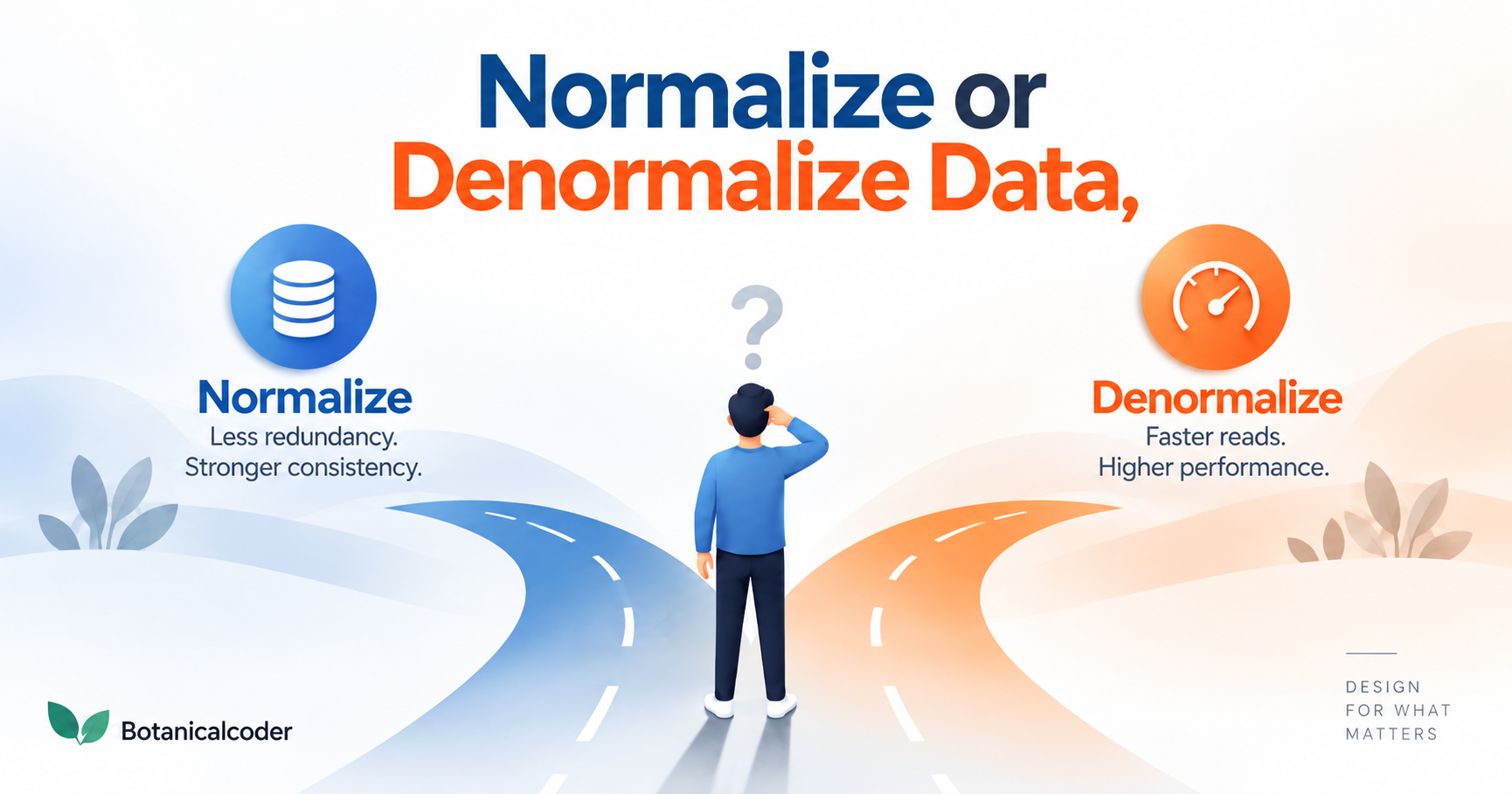
Normalize or Denormalize Data, which path is correct?
I am a developer from Lagos, Nigeria who loves wealth creation and good Music. When I am not coding or thinking up ways to move forward I DANCE
An important decision that is made during database design is the tradeoff between reducing redundancy to preserve data integrity (Normalization) versus accepting redundancy to boost read efficiency (Denormalization). Both strategies have their benefits but this depends on the different workload patterns. Data Normalization Normalization is the process of structuring a relational database typically through First Normal Form (1NF) up to Third Normal Form (3NF) or Boyce-Codd Normal Form (BCNF) to minimize data redundancy and eliminate update, insertion, and deletion anomalies.
You can look up these terms but in essence what this does is proper separation of concern on the db level to avoid repetition. Core Principles Single Source of Truth: Each independent fact is represented in one authoritative logical location, reducing unnecessary duplication and the risk of inconsistent updates. Decomposition: Large tables containing repeated values are split into smaller, linked tables using primary and foreign key relationships. When should you Normalize ? OLTP (Online Transaction Processing) Systems: Applications characterized by high-volume, concurrent write operations, such as e-commerce order processing, banking systems, and inventory management. Strict Consistency & Accuracy Requirements: Normalization is useful when relationships and business facts must remain consistent and duplication should be minimized. Transactional guarantees such as ACID complement normalization but are separate database properties. Evolving Business Logic: Applications where domain requirements change frequently, requiring flexible queries without modifying underlying schema structures. Advantages Correctness & Consistency: Because data exists in only one place, updating a record requires a single write operation. This prevents data drift or inconsistencies across tables. Storage Efficiency: Reduces unnecessary duplication of values across rows and tables, which can lower storage requirements for some workloads. Flexibility: A normalized schema allows ad-hoc queries and complex filters without forcing the query engine into rigid access patterns. Disadvantages & Operational Complexity Read Latency (Query Complexity): Reconstructing complete domain objects may require multiple JOINs. Well-indexed JOINs can be very efficient, but complex relationships, large intermediate result sets, poor indexing, or unfavorable query plans can increase CPU, memory usage, I/O, and latency. Indexing Overhead: Normalized schemas often benefit from indexes on foreign-key and frequently joined columns. These indexes consume additional storage and add maintenance cost to INSERT, UPDATE, and DELETE operations. Data Denormalization Denormalization is the intentional introduction of redundant data or pre-aggregated fields into a database schema to speed up complex read queries. Core Principles Read Optimization: Storing related data together in a single table or row to avoid expensive multi-table JOIN operations. Pre-Computation: Calculating and storing aggregates, such as total_order_amount and item_count, ahead of time rather than aggregating dynamically on read. When should you Denormalize ? Read-Heavy Operational Workloads: Feeds, product catalogs, profile pages, and high-traffic APIs where predictable low-latency reads dominate. Analytical Workloads: Reporting, BI dashboards, data warehouses, and aggregate-heavy workloads where denormalized dimensional models can reduce query complexity. Latency-Sensitive Read Paths: Frequently executed queries where repeated JOINs, aggregation, or computation have been demonstrated through profiling to be a bottleneck. Distributed / NoSQL Databases: Denormalization is common in systems such as DynamoDB and Cassandra where data models are designed around known access patterns and server-side relational JOINs are unavailable or intentionally avoided. Document databases such as MongoDB also support join-like operations, but embedding related data is often useful when the access pattern permits it. Advantages Query Performance: Denormalization can eliminate some JOINs and repeated aggregations, reducing query work for known access patterns. However, very wide records may increase I/O when only a small subset of fields is required. Simpler Read Queries: Applications write simpler SQL queries without multi-level JOIN, GROUP BY, or window functions. Disadvantages & Operational Complexity Synchronization Complexity & Potential Consistency Problems: When redundant copies cannot be updated atomically, particularly across distributed systems, temporary inconsistencies and eventual-consistency behavior may occur. Write Overhead: Writes become slower and more complex because the application or background workers must maintain synchronization across redundant stores. Increased Storage: Redundant strings, nested structures, and pre-calculated columns increase overall storage volume. Side-by-Side Comparison Metric / Dimension Normalized Schema (3NF) Denormalized Schema Primary Goal Reduce unnecessary redundancy and prevent modification anomalies Maximize read performance and speed Optimal Workload Transactional systems and systems with frequently changing relational data Read-heavy APIs, analytics, reporting, search, and distributed read models Read Speed Can require JOINs; performance depends heavily on indexes, cardinality, and execution plans Can reduce JOINs and runtime aggregation for known access patterns Write Complexity Usually easier to keep consistent, but operations may span multiple related tables May require redundant values or derived models to be updated Write Performance Workload-dependent Workload-dependent; synchronization may increase write cost Data Integrity Enforced natively via DB constraints Enforced via application logic or async sync Storage Usually reduces unnecessary duplication Usually requires additional storage Query Flexibility High; supports arbitrary ad-hoc queries Low; optimized for specific read patterns Consistency Risk Lower risk of redundant facts drifting apart Greater risk when duplicated representations cannot be updated atomically
Architectural Patterns & Practical Strategy Most modern production systems do not choose purely one or the other; instead, they combine both strategies.
Normalize First, Denormalize on Demand Start with a clean, normalized schema (3NF). Only denormalize specific bottlenecks after profiling real-world query execution paths and database metrics.
Read-Replicas and Materialized Views Keep authoritative transactional data normalized while creating read-optimized representations through materialized views, summary tables, caches, search indexes, or ETL/ELT pipelines.
CQRS (Command Query Responsibility Segregation) Separate models used for modifying data from those used for retrieving data. The command side may use a normalized transactional model, while the query side may expose denormalized read models. These models can live in the same database or entirely separate storage systems.